|
The Arts Beat is a weekly deep-dive into Memphis arts, music, dance, theater, fashion, film and events. Keep scrolling for a roundup of the best arts and culture stories from the week. Have a story idea? Send it to eperry@dailymemphian.com.
After her second miscarriage, Emily Skaja was a ghost, a conspiracy theorist, a transparent eyeball, a mother to a loaf of bread.
That is what the Memphis poet pens in her latest book “Black Lake,” an exploration of her two pregnancy losses as she maps her grief and its surprises. “Black Lake” is available Sept. 8 with a special dual-release party at Novel.
“In the six months directly following my second pregnancy loss,” Skaja said, “I felt like I was being poisoned by grief and that I just had to get that out of myself in whatever way that I could. So these poems came pouring out of me.”
Planting something
Hailing from rural Illinois, Skaja always wanted to tell stories. One of her professors encouraged her to go into poetry.
Her first book “Brute,” a product of her grad school work, won her the Walt Whitman Award in 2018, a prestigious literary prize from the Academy of American Poets.
She has also racked up fellowships and awards from the Civitella Ranieri Foundation, the Tennessee Arts Commission and the National Endowment for the Arts and has been published in American Poetry Review, The Nation and Poetry magazine, to name a few of her accolades.
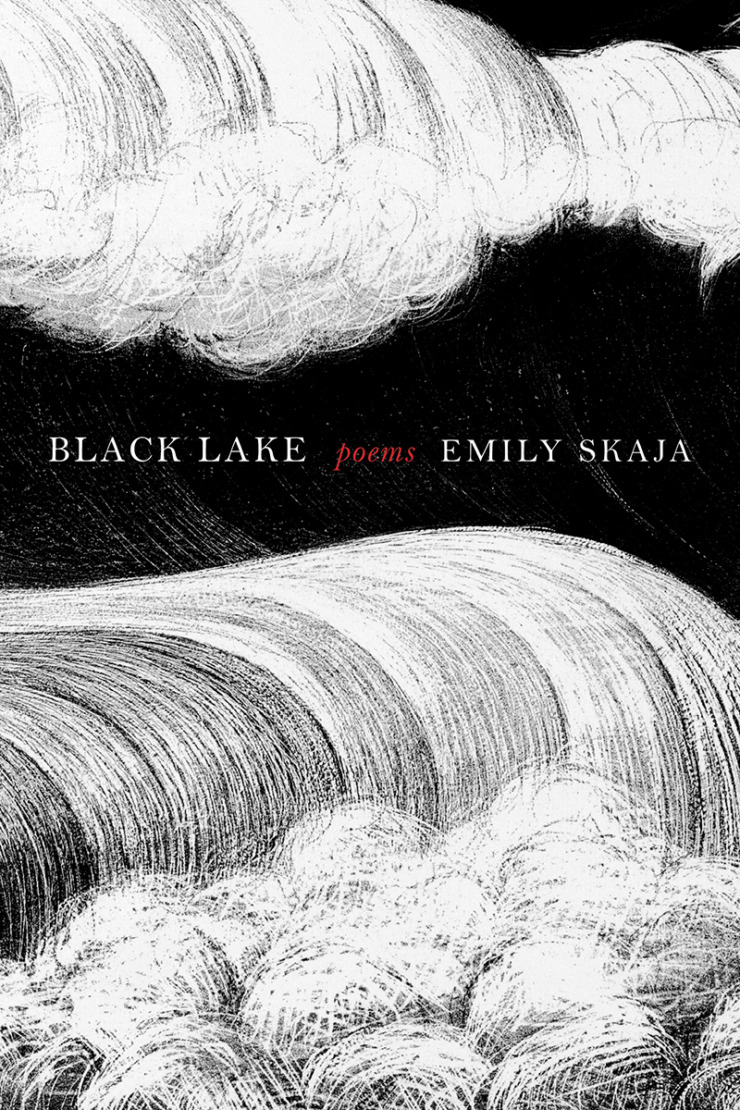 "Black Lake" by Emily Skaja comes out Sept. 8. (Courtesy Emily Skaja)
Now, she teaches poetry in the Master of Fine Arts program at the University of Memphis.
Skaja never saw herself living in the South. Now, she’s planted roots in Memphis in more ways than one.
In her 30s, Skaja became obsessed with gardening. Gathering houseplants and planting trees, she was suddenly invested in nurturing something beautiful.
“I don’t think I really put together for a while that that was probably related to wanting to start a family,” Skaja said. “It seems obvious. Someone else could have pointed that out to me probably, but I did not notice that about myself.”
Perhaps that is why she was drawn to the Midtown Nursery on Poplar Avenue and East Parkway.
Skaja has always been lured in by the drama of that corner — music from passing cars, protesters outside Planned Parenthood, plant shoppers moseying around the nursery.
It’s in this tension Skaja opens her book with a poem called “Plant Parenthood.” In the poem, she stalks through those aisles, reeling from the sorrow and rage of her first miscarriage. The tone is gnarly and biting, washing readers in a wave of bitter grief.
“The shock of grief is angry,” Skaja said. “And I felt scathing at the beginning of these losses.”
Grief, surprises and a bittersweet love poem
 Emily Skaja, left, and Marcus Wicker both teach in the Master of Fine Arts program at the University of Memphis. (Courtesy Emily Skaja)
As the book progresses, readers can follow the shape of that sadness as it morphs into anger, melancholy and, sometimes, even humor. The poems change in tone and scope from the freshness of the losses, the dull drone of a deep depression and what grew in between it all along the way.
A piece that surprised Skaja was “Goodbye to All That,” which won the Copper Nickel Prize. It’s an unexpected love poem that bloomed from anxiety before a surgery.
“I am a person who writes poems mostly about sad, difficult things,” Skaja said. “But in the process of writing about this particular sad, difficult thing, I wrote a bittersweet love poem.”
In the poem, she is anxious and crying, waiting to go into a dilation and curettage procedure, a surgery that empties the uterus. Through all this, her husband is holding her hand right at her side.
That’s actually often where you can find her husband, Marcus Wicker, who is also a poetry professor at the U of M.
In fact, Wicker has his own book of poems coming out jointly alongside “Black Lake” on Sept. 8, “Dear Mothership.” While the two books are different, both explore connection at their core.
“We’re both thinking about how to stay connected to other people, to our art and our identities when the world around us feels so unstable,” Wicker said.
The poets often share drafts with each other, and eagle-eyed readers might catch experiences, feelings — even a hibiscus tree — that cross between books, but each with each author’s perspective.

“We’ve been sharing poems and teaching together for long enough now that we can sense when one of us is hiding, over- or underwriting a poem,” Wicker said. “It’s a real gift to be married to someone as talented and brilliant as (Emily).
“I think we make one another better, on the page and off.”
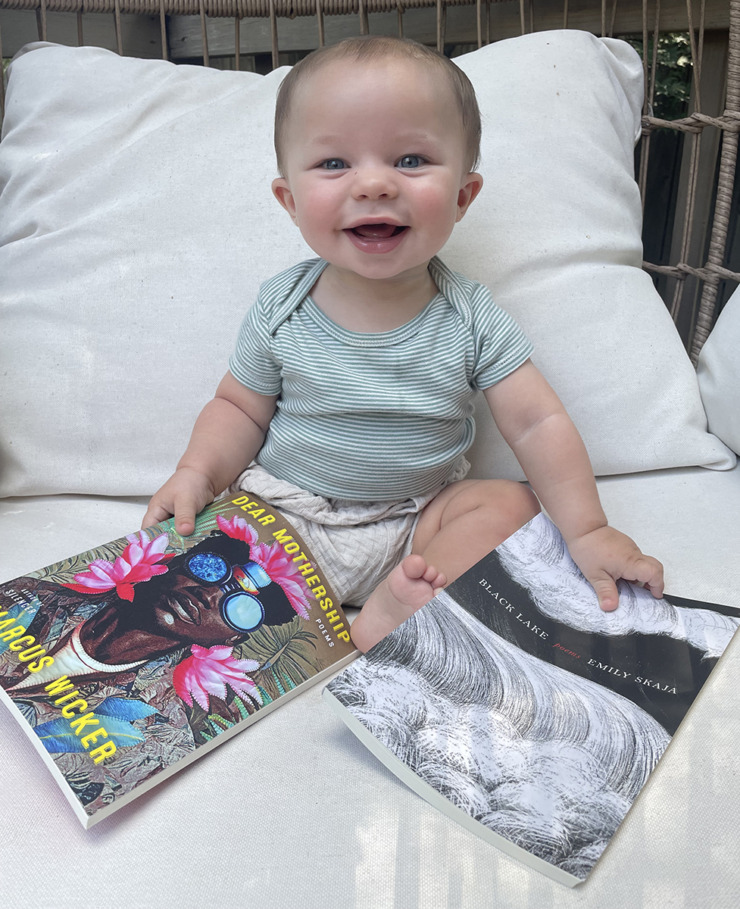 August Wicker, 8 months, at home in his backyard holding copies of the books his parents wrote about experiencing recurrent pregnancy loss before he was born. (Courtesy Emily Skaja).
Wicker said Skaja captures complex experiences without flattening them, describing her book as “alchemical.” Not too preachy or heavy-handed, he said, the book poignantly navigates difficult subject matter with a vulnerability and humor that “creates unexpected moments of catharsis.”
“I watched Emily make art of her hurt over and over again,” Wicker said. “Sometimes she’d disappear into her office for hours and come out at the end of a long day with two or three remarkable drafts and a trashcan full of Kleenex.”
Still, more surprises awaited the couple. After she finished “Black Lake,” Skaja found out she was pregnant again. Today, she and Wicker are now parents to a happy baby boy, August.
“We had this miracle baby who came into our lives despite all the odds,” Skaja said.
‘I have to sit with it’
There are about 1 million miscarriages in the U.S. every year, according to the Yale School of Medicine. More than 20,000 end in stillbirth at or beyond 20 weeks of gestation.
“A lot of people after my first miscarriage said to me, ‘Oh, don’t worry … this happens all the time. It doesn’t mean that it’s going to happen to you twice,’” Skaja said.
But it did. She had her first miscarriage in 2023, and her second in fall 2024.
There is secrecy around miscarriage, Skaja thinks. For an event so common, the conversation seems to her mostly silent. Either people don’t want to hear about it or don’t want to bring it up, she said, which makes it even more isolating.
When she started writing “Black Lake,” Skaja expected to document her journey to the end of her grief. That’s not how it played out.
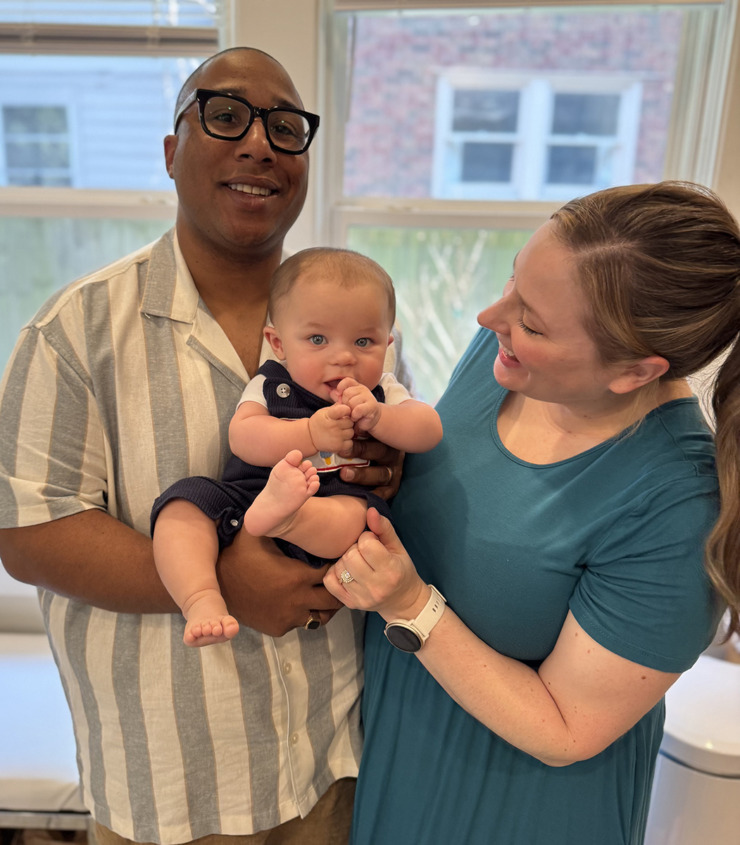 Emily Skaja, Marcus Wicker and baby August spend time together at home in July 2026. (Courtesy La Cheryl Wicker)
“I had a kind of crisis in the process of writing this book,” Skaja said. “I had this idea that I would feel healed at some point. … You know, I’d write these poems that were about how I triumphed over this deep darkness that I had sunken into. But that didn’t happen.”
It left her feeling lost, and the realization forced a shift, Skaja said. She had to let her emotions write the poems that shaped the book.
“I had to have a reckoning with myself toward the end of this project,” she said. “Maybe the arc of this book is not from deep sadness to joy. Maybe it’s more like from grief to acceptance. … Maybe if I just accept that I can’t change anything about this awful feeling. I have to sit with it.
“Maybe that in itself is a big enough move away from the initial shock of grief. That it would feel like a complete arc. And so that’s the book that I wound up writing, but it really surprised me.”
After her first book, which is about surviving domestic abuse in a previous relationship, she was moved by the people who confided in her about sharing the same experiences.
“It meant a lot to me to hear that at the time because … I had all this shame about it,” Skaja said.
Amid this grief, sorrow and surprising love that can be difficult to talk about, Skaja said she wants “Black Lake” to do the same.
“I hope that this book would be a companion to somebody who has gone through the same feelings,” Skaja said. “For me, like, it has been really touching to feel like I’m in solidarity with other people who’ve gone through these same experiences.”
Top arts and culture stories

..... |